Updates from the Classroom and Elsewhere

I’ve been reading and writing-o-rama this week and it’s going very smoothly. I have figured out how to manage my time here—by spreading out the workload throughout the week. Instead of doing everything on the weekend or the day before an assignment is due, I sprinkle little pieces of assignments on every day of the calendar. This not only keeps stress levels low; it keeps my fingers and my mind limber as I practice my skills every day and not on just one day of total brain blast.

It occurred to me that some of you blog readers out there may be curious what I’ve been doing in my classes lately! So this is the blog post in which I tell you:

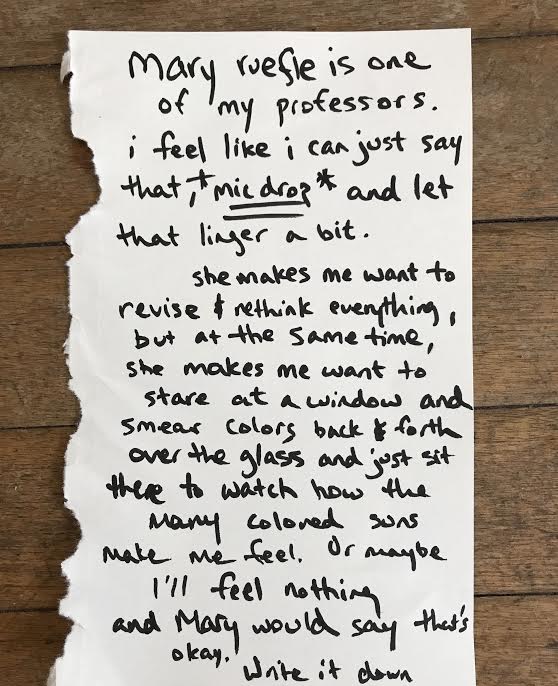
  • What do you see when you stare at a fountain? This is the assignment Mary Ruefle gave to us for the last week of our three week module with her. There is a fountain out front of College Hall and throughout the week, her students sat on a bench and pondered the fountain. Our write-up could be any genre. The fountain could appear or not appear in the piece. The only true limitation was that the piece couldn’t be more than one page in length. It was fascinating how the fountain had influenced every single person in such different ways. In some cases, the fountain was a subject to be analyzed and described architecturally. In others, the fountain was absent in the piece and was a means of remembering a childhood memory. And for me, as I sat by the fountain, a scene unfolded before me and I saw so powerfully a tender moment between two characters that could not pass unwritten. The purpose of this assignment is an important one for all writers: when writer block hits, find something in real life to sit and really stare at. The world is our prompt. The thoughts will come when you use your senses and just be.
  • What does a sestina have in common with the first five minutes of The Social Network screenplay? Well, for starters, repetition of concrete words and subject matter layered in a circular way so the words revolve like a dry cleaning assembly line, always appearing just as you think the subject was dropped. See for yourself! Watch the opening scene of The Social Network and then read this poem by John Ashbery.

  • Speaking of Mark Zuckerberg, I learned tricks of the HTML trade and brought code to life on www.practiceboard.com. Now that I can use code to change font face, color, size, style, as well as indent, hyperlink, and create numbered lists, I feel so marketable all of a sudden. And to be honest, a bit amazed. Through HTML, we witness two languages instructing and cooperating with each other. I know that HTML is just the beginning of code, but it really is like breaking into another way of seeing, of thinking, of organizing those thoughts.
  • My program requires us to work at least 15 hours per semester as an Intern for an Arts/Literary Organization. As soon as I heard about May Day Studio (a quirky maker of letterpressed goods), I knew I wanted to be an intern there. This is my first time working in a letterpress studio, and I love it. From the moment I put on my apron, I become an apprentice. So far, my main task is to “distribute” typefaces my boss uses for projects back to their proper galleys (or trays). Every once in a while, she calls me over to observe what she is doing. Last Thursday, she taught me how to mix inks to create color blends using the Pantone Formula Guide. Then, she used a printing press to embed a design into a blank drink coaster and voila! In a few weeks, I will begin my own letterpress project—I’m thinking bookmarks or pocket poetry cards?

  • I’m embarking on a new novel project, which I can’t even say how exciting it is. I’ve been in short story mode for so long, so I feel like I’m diving off the high dive sort of fumbling with my own feathers and my swim cap is half over my eyes, but I know that when I reach the water’s surface, I will have found a way to enter the pool in my own streamlined way. I won’t spill too much information about this project yet, since it is still in its early stages. For now, free-writing to discover voice is my number one priority. But I can tell you that the idea for this novel came from a visualization exercise I came up with in class:

On a dresser drawer sits a metal tin. It may or may not be filled with anything. A person opens the door to the bedroom. They aren’t supposed to be there. This person looks nervous and frequently checks over their shoulder. This person places their hand on the tin and opens it. They look inside and see—

That’s all for now! Tonight is the Vermont Book Award gala, so look forward to an upcoming post about the event! Happy Autumn!

On the Cusp of Autumn

First weeks are hard. There are countless adjustments to be made: new time schedules, meeting new people, figuring out where you need to be at what time, and of course, there are tons of assignments to be done. It is imperative to keep track of what is being asked of you, because your body and mind are surely being asked to stretch into a zillion directions. (Carl Sagan, I’m sorry, we are not made of star stuff, we are made of Silly Putty.) But, as a master of the sticky-note, my desk is plotted like a military graveyard with periwinkle and teal Post-Its, describing each and every task I need to accomplish (with only minor coffee stains coloring the text).

I’ll quickly share a few of my greatest experiences this week during class:

Julianna Baggott, my Forms professor, is a prolific writing superstar. She has perfected something called “Efficient Creativity”: the art of writing without being at your desk. By this, she means that she is always creating scenes in her head while taking care of children or driving in the car or walking through the grocery store, so when she sits down to her computer, she already knows what she is going to write. Because of this method, she has written 20+ books while taking care of four children, holding two professorial gigs, and managing to do other human things, like sleep, eat, relax, exercise, go out. One of her goals for our class is to help us become more efficient writers and through that, she believes in running writing drills, which I actually love! For me, drills aren’t only for me to practice my skill and actually WRITE, but they are an opportunity to play and experiment in a pressure-free space. For example, one of the drills included using our own memories inspired by random words (think: snake, teeth, scar, bad job, fire) and then threading those memories together to create an outline for a short story. In addition to these drills, we also read and critically respond to fabulous short stories: “The Rememberer” by Aimee Bender, “Sweetheart of the Song Tra Bong,” by Tim O’Brien, “My Man Bovanne,” by Toni Cade Bambara, and “The Owls,” by Lewis (Buddy) Nordan.

-My latest room decorating project was also inspired by Baggott. She suggested that instead of constantly worrying about how we compare to the others in the MFA program, we should be looking up at the horizon, at those writers and artists who we admire and strive to emulate. She said we should print out their pictures and hang them above our writing space so we can always have their spirit near us. For me, it was very important to have my wall enriched with the faces of inspiring and innovative female artists—the women who weren’t afraid to create something new and push back on any boundaries set on art. This is only the first half that I’ve been able to put up so far, but there are more coming! I may need more wall. 

-This week also saw my first day on the job as Managing Editor of VCFA’s Hunger Mountain annual literary and art journal. I gratefully received this position by winning the Editorial Fellowship and I already know that this is a place I was meant to be. I love the energy and camaraderie that is felt in that office, as I work alongside Editor-in-Chief, Miciah Gault and Program Assistant, Lizzy Fox. I love that I have a direct connection with all of the writers who contribute to the magazine. My first correspondence with many of the writers was to congratulate the winners of our 2017 writing contests. I am so happy to be able to contribute my energy and ideas into creating a tighter-knit writing community. Writers need to support each other and this position will allow me to help make other writers shine in the unique glow that VCFA has to offer. I work 10-15 hours a week on top of classes, and do a little bit of everything on the journal, so again, sticky notes are a savior.

In other news, what with all of the homework to do, during nights and weekends, I am in a sort of cocoon of coffee and green tea and writing and reading, accompanied by the sonic comforts of Philip Glass, Zoe Keating, Tycho, and Emancipator.

It feels like it could trip over autumn at any moment. It’s summer sunny and yet the air is getting crisper, like someone above poured extra bits of oxygen into our airy fishbowl. I am loving wearing layers of sweaters and jackets and scarves. My nose is on full alert for pumpkin spices. It is my favorite time of year, all cinnamon and leaves and the sound of breeze rustling the earth. Any day now.

But for now, there are still sunflowers and beautiful birch trees and that’s okay, too.

September Readings

I’ve had a very long, very productive weekend. Went to see The Glass Castle, received a very detailed guided tour of the State House by an extremely jolly policeman, cleaned my studio (sort of), dove back into the nerdy pleasures of having homework again, wrote a lot, read a lot. Somewhere in there, it rained and I had wine and I happened upon a stony tower on a hill.

The Tower in Hubbard Park

Before my first class on Tuesday, I’m trying to squeeze in as many “books for fun” as I can before readings are assigned to me—which I will surely love to read just as much. Note: the title “books for fun” is simply just a label of differentiation between assigned and non-assigned readings.

I read The Stranger in the Woods in little under two days. A fascinating read about a fascinating person. This interview with the author, Michael Finkel, is also something to consider.

Tana French is my go-to detective/crime recommendation lately and her newest book, The Trespasser, is all the shades of Irish sass and mysterious intrigue you’ve been waiting for.

I love reading about how other writers perceive the world and strain through their observations and categorize their many story ideas. I also love Virginia Woolf, so naturally, the excerpts of her diary anthologized under the title A Writer’s Diary just fell into my hands.

I picked up Max Porter’s Grief is the Thing With Feathers because I’ve been meaning to read it for months now and it is just short enough that I can pretend that it will take me a day to read, even though (let’s be serious) shorter books always take much longer to read because I agonize over internalizing each and every word. Shorter books are like poetry to me. I care for each word my eyes pass over. I study those words and their placement. I indulge in their sound.

In other things I’ve been reading, I wanted to touch on books about the craft of writing. I am interested in them mostly just to see what other people have to say about the thing I love to do, and how so many people can say the same thing in so many different ways. One of these books I read this weekend while plopped in a floofy chair at Bear Pond Books. It’s called The War of Art by Steven Pressfield. It’s very straightforward, very thoughtful and a no-nonsense call to action for anyone struggling with anything from writing and painting to weight loss and yoga. It is very clear and concise, and frames familiar struggles in terms of battling with RESISTANCE (this nebulous force that is constantly fighting against you). It’s a quick read, and I have a feeling I will be re-reading it whenever I need a frank reminder to be fearless and just GO FOR IT.

I am looking forward to this week of new classes and new perspectives. I have a lot to write, I have much to say. I have the soundtrack to Midnight in Paris freshly downloaded and I still have quite a bit of wine left, too. Cheers!

On Paper Journals and How to Use Them

One thing I always look forward to doing as far as “back-to-school” shopping goes (gosh, I feel old just saying that) is buying new journals.

For academic course journals, I’m a fan of the trusty old Composition Book. I love the contrast of the dark binding with the busy rorschach-esque splatter pattern. Like a nice proper note jotter with a crazy side. Nowadays, these journals can be found in many colors besides black and white. This is mainly a plus because I happen to have a strange, synesthetic color-coded system when it comes to class notebooks. Here’s what it is: when I get my class list for the semester and I read each course title, a color immediately appears in my brain and gets paired with specific said title. So for example, this semester at VCFA, I am taking:

  • Modules (made up of several 3-week intensive cross-genre workshops and seminars, built around common themes, and taught by various faculty members)
  • Forms (exploring various written work and films critically and creatively, as well as participating in in-class writing exercises)
  • Publishing & Fieldwork (Gaining professional experience editing literary mags, interviewing writers, editors, agents, and investigating publishing endeavors and arts-related careers)
  • Professional Development (Airtime for practical literary matters, formatted as Q&A, generative & practice-based exercises, and discussion about professional trajectories)

Naturally in my head, the color-coding ended up like this:

  • Modules: blue and yellow
  • Forms: green
  • Publishing: red
  • PD: traditional black and white

So now, I have five lovely new journals for the semester—my own mini writing rainbow. And with no doubt, they will fill up with ink pretty darn quick.

Now on the other hand, non-academic journals are a different story. I love blank books. At bookstores, I enjoy a good paw-through of the section with diaries and sketchbooks and planners. I love the crispness of blank white pages and the texture of the unwrinkled cover and the bound book spines you have to crack open. In fact, I have a collection of them, buried somewhere under my bed, all acquired over several years. Some I have bought myself and others have been given to me.

Several (as in most) of these books are still blank.

Why is this? I think it’s that there are too many possibilities of what to put on that first page. I not only worry that my handwriting isn’t good enough or that I’ll use the wrong kind of pen, I tend to think about the purpose of the journal. Instead of taking it page by page, I think of the journal as a whole. As a kind of self-contained novel in itself.This might come from a sense of nostalgia for the types of journals Jane Austen or Virginia Woolf would have kept. These books of theirs have become artifacts of their lives. That sort of significance weighing on one’s private diary is enough intimidation on its own.

The thing is, I actually really love writing by hand. I find typing easier, but I love the act of putting ink to paper. I like not having to follow lines, which is why I prefer unlined journals to lined ones. I tend to write in blocks, add arrows and marginal doodles, and practice unique hand-drawn fonts. In a way, my written journals isn’t necessarily about the substance; instead it’s more about the aesthetic of the page.

Blogging seems easier to me, but perhaps it is just a different writing creature of its own. Serving a unique purpose that paper can’t provide for me. Maybe it’s easier because websites are developed without any lines. Maybe because there is an innate ability to work “undercover” from behind the screen. One can erase a word and retry a thousand times and no one would know the better. Hell, you could even delete an entire blog post if you so desired. Any post can be the last post. Each post is separate and yet still connected by a thin digital thread.

And yet, I’m still drawn to the paper journal. Because I love to feel their weight in my hands. Because they are a type of documentation with a lifetime guarantee stamp of permanence. Because it’s hard to color-code a class title by blog posts.


On Tackling the Art of Self-Revising

In the past few days, I’ve been doing lots of revision to two of my newest short stories, and it’s hard for me to gauge how the process is going.

Revisionland is a place I really learned how to navigate while I was a student at University of Michigan. I had the amazing experience to take a one-on-one writing “tutorial” with my professor, Laura Thomas, where each week, we’d meet in her office and I’d alternate between crafting a new piece or editing an older draft. I came to trust Laura’s eye for proper story arcs, improvements to character development, voice inconsistencies, and minor grammatical proofreading. My first-draft writing style tends toward the overwriting than the underwriting. Which is great in some ways because I have more to work with. The catch is that there’s often TOO much that is unnecessary to the central plot and there’s little I hate more than killing my linguistic darlings. Before I met Laura, the revision process looked to me a bit like the precipice of a giant roller coaster, where all you can see is open sky and a suspended track and you pray to whatever’s out there that there is track attached to the other side of the bell curve and that you’ve said “I love you” to all who care for you deeply in case you don’t make it. For the three years I spent with Laura as my own personal editor, I felt like I figured it out. I knew what to look for when I read back through my own drafts. I knew how to expand, how to cut, how to be ruthless, how to rephrase, and how to add details that progressed the story and didn’t distract the reader. I felt like I could release my grip on the roller coaster’s safety bar and raise my hands up high.

Now that I’ve been out of school for a year without my own personal beta reader and editor, I’ve had to fill that role myself and I feel like I’ve had to reteach myself everything. Which is funny because I don’t feel that way at all when I read other people’s work. I’ve been part of workshops in the past year and have received gracious compliments on the feedback I’ve given to others. In fact, I have many writing buddies who seek me out to read their early drafts and cover letters. And yet, I have so much difficulty looking at my own writing with those same critical eyes. It must be something about the distance (or lack of distance) we have to our own writing. We can justify every single word on the page and bicker with ourselves about why we put it there and why we HAVE to keep it. And all too often, we give in to our persuasive word hoarder part of the brain.

Another tricky part about self-editing is knowing when you are done editing. In contrast, when I paint, I can see and feel when something is done. It’s all there, on a neatly contained canvas, so I can see it all at once and acknowledge that yes, this project is finished, it is complete. But it’s so much harder when you have thousands of words, spread upon a number of loose pages, and you have to look at each detail piece by piece. It’s as if you had a book, but printed on each page you have a whole lot of white space and one single puzzle piece to a 1,000 piece puzzle. You must flip to each separate page to discern the piece. How do you know when all pieces are accounted for and the puzzle becomes an intelligible image, not just clusters of colored cardboard shapes? Ahh, the great mysteries of art-making (but isn’t it these mysteries, these challenges, that keep us at this work we love?)

This is what my counter looks like right now:

I know I am not the only one who struggles with editing, which is why I’m determined to tackle it head on. This is what seems to work for me:

  • Printing out all of the pages of the story so I can see them clearly and all at once.
  • Lay them out on a large table or the floor.
  • Use your favorite editing pen (mine is a PaperMate Flair M Felt Tip in Purple)
  • Read through each page out loud. Mark phrases that are too wordy, hard to pronounce, or don’t seem to convey what you intended.
  • Pretend it’s someone else’s piece. If you hate criticizing your own, take on a new identity for this task!
  • Just as if you were marking up the margins of your favorite book, write anything that comes to mind. Stream of consciousness, questions, musings, doodles, etc. The more you mark up and get down on paper, the better your next edits will be. Unclog your mind while editing. That’s where the anxiety lies, I’ve found: when you are trying to store too many things in your brain because you are ashamed to write them down. Remember: these edits are for YOU and your eyes only.

I’m curious as to what other people do to help them triumph over the editing hump and proceed through Revisionland unscathed? Leave a note in the comments!